Monday, 24 August 2020

A changing world.


The library has recently reopened after almost 5 months. Just before lockdown they had increased the number of books you could borrow from eight to twenty five. I took advantage of this and just before they had to close I took out the maximum. I mainly chose children's books because I knew I would be home schooling.
This week I was able to return them but you have to order a book in advance if you wish to borrow anything. The other option was a lucky dip. A pre chosen selection under headings such as romance, thrillers, crime etc. I chose general fiction and when  was pleasantly surprised when got home and opened the bag.


In the evening I met up with a couple of friends for a socially distanced open air cinema.

It took place in the grounds of Leeds castle in Kent.  Although you can see it very well from this photo, the backdrop to the screen was the castle.


At the beginning of the week I went with my daughter and my two grandchildren to the Kent coast. The weather was perfect as it wasn't too hot and as the forecast was rain there were no crowds. Fortunately it didn't rain and they loved playing in the sea and the sand. We stayed overnight in a hotel  which had observed all the rules and I felt more than happy to stay there.  The only downside was in the evening when I unpacked my bag and I discovered that my grandson (2yrs old) had put his drinking cup into my bag and soaked my camera! Far too late to remedy the situation. I did have accidental damage insurance for the camera as just 3 years ago I ruined my last camera when I dropped in in mud and on buying this one I took out added insurance. Sadly the insurance ran out in April and it was non renewable.

Monday, 10 August 2020

Cable Street Mural

 On a plaque next to the mural is the following information:
 On the 4th October 1936 the people of the East End halted a march by fascists in what has gone down in history as 'The Battle of Cable Street'. People from the Jewish community, communists, trade unionists, Labour Party members, Irish dockers and labourers joined forces to oppose the march through Stepney planned by Sir Oswald Mosley, leader of the British Union of Fascists (BUF) and thousands of his followers known as 'Blackshirts'. Their uniforms echoed their counterparts in Italy and Germany.
The planned route was through an impoverished area with a high concentration of Jewish residents and was seen as a deliberate act of provocation. The government of the day refused the request by Jewish local and community groups to ban the march and on the day over 250,000 East Londoners took to the street to bar the way to British fascism. The Spanish Civil War had begun a few months earlier and opposition to Mosley's Blackshirts was seen as the same struggle as that being fought by the Spanish Republicans against Franco's German and Italian backed Nationalists. The slogan used by the Republicans in the defence of Madrid was adopted at the barricades in Cable Street - They shall not pass ( No pasaran).

The ensuing action ensured that Mosley's marchers were turned back and political history was made. One resulting legacy was the Public Order Act of 1936, banning the wearing of political uniforms in public. More importantly, on the day, the fascists did not pass and the people of the EastEnd played a crucial role in the defeat of organised British Fascism for decades to come.

 The battle is well documented. More information can be found at www.cablestreet.uk There was a lot of violence that day aimed at the police who were given the task of allowing the march to take place. There were 79 anti-fascist men and women arrested, many of them severely beaten by police. In contrast just five fascists were arrested.


The mural is painted on the side wall of St George's town hall and was started in 1976 by Dave Binnington. Due to several acts of vandalism he was unable to complete the project. The work was finally completed by three other artists: Paul Butler, Ray Walker and Desmond Rochfort in 1983. It was restored in 2011.


Sharing with Our World Tuesday


Monday, 3 August 2020

Docklands

I decided to return to Greenwich Park at the weekend. As it was a Sunday I was able to park the car which meant I had the time and energy to walk from the park over to Docklands. From the top of the park you have a good view of the skyscrapers of Docklands.

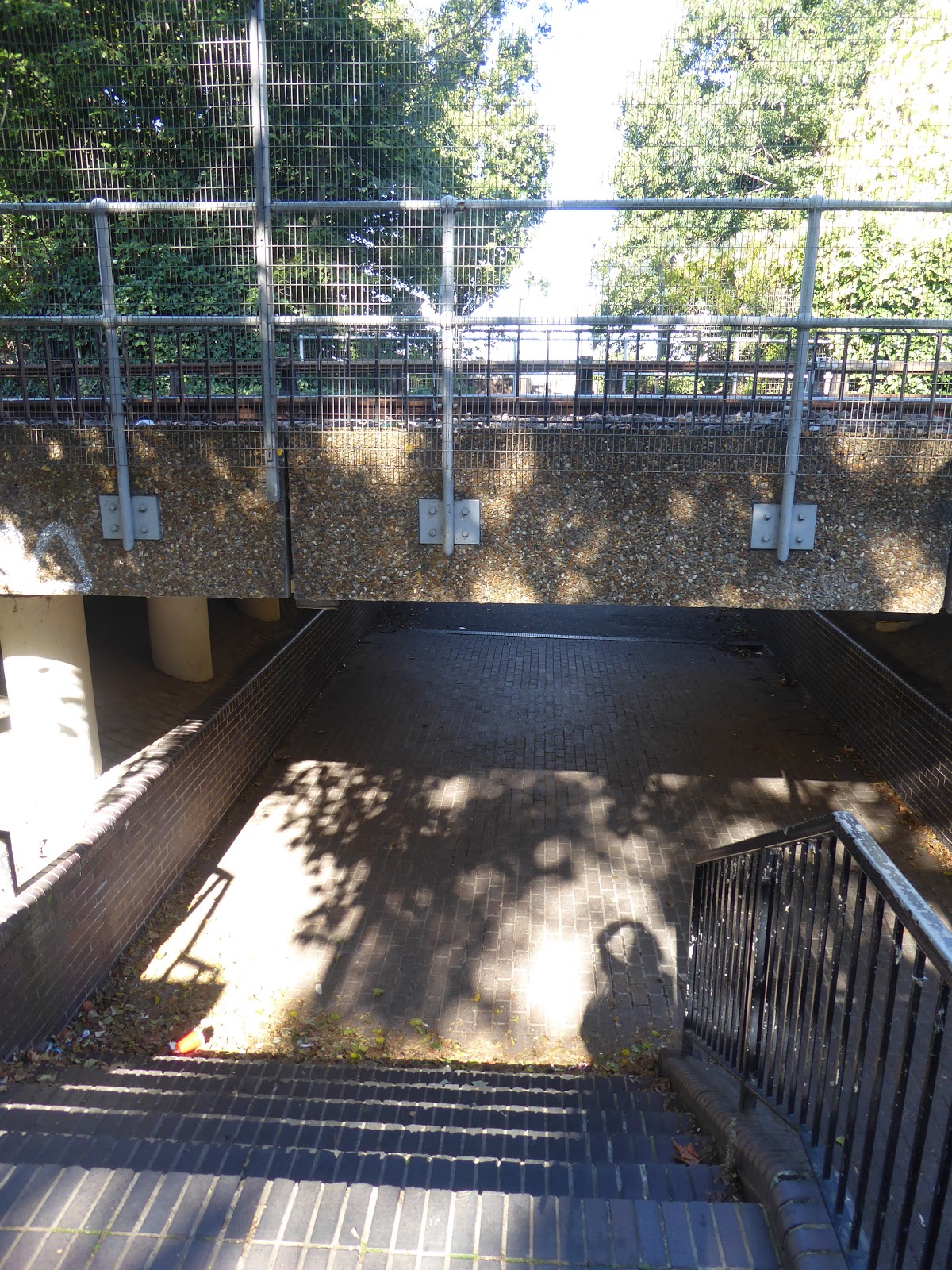
 Docklands is across the River Thames from Greenwich and can be reached by walking through the tunnel under the river. This rotunda is the entrance on the south side. There is a similar one on the other side.

The tunnel opened in 1902 and is 370m long. It was built to give people easy access to the docks. There are steps and lifts down to the tunnel. There are fewer steps on the north side than on the south side of the river. I stopped counting when I got to 100!

Looking back towards the Cutty Sark in Greenwich.


This is Millwall Park with the arches of an old railway line on the right and the ventilation shafts ( I think) of the Docklands Light Railway on the left.


Unusual to see a full quota of rental bikes.

Canary Wharf is not looking so far away now.


I walked beneath the Docklands Light Railway to come out at one of the quays.


These flowers were growing from beneath the concrete wall of the quay. I have no idea what they are but they looked very impressive.


To me  the buildings are built too close to one another.


I did come across one road of older houses.


Look at the height of this crane!


Canary Wharf tube station.


The roof garden above the new Canary Wharf Crossrail station, not the tube station above.
 

 There are numerous sculptures to be found in the parks and in front of the buildings. Here's just a couple of them:


'Returning to embrace' by Jon Buck
 'It takes two' by Bob Allen


I returned to Greenwich Park more or less via the same route.  By the time I got back to the car I had walked 9 miles.

Thursday, 30 July 2020

Greenwich Park

My walk today took me to Greenwich Park, always a favourite.


Sunday, 26 July 2020

Slave sculpture


Very early on Saturday morning I decided to travel into London. It has been 4.5 months since I was last in town. Normally I would go into London two or three times a week. As you can see the train was almost empty, probably because it was just after 7am. When I left the station the only people I saw were security guards, builders and a few homeless people. During the Covid crisis, the homeless were found places to stay in hostels or hotels but some people can't cope being trapped inside four walls. I did chat to one man who said he was happier living outside on the streets. 
My plan was to walk to Whitechapel, the next underground station I wanted to visit. This meant a walk through the City of London, the financial district, which is always quiet on a Saturday anyway. I walked through Fen Court which I hadn't noticed before. Fen Court is the site of a churchyard ' St  Gabriel's of Fenchurch Street'. In the centre was a sculpture that I found intriguing. It is called 'Gilt of Cain' by Michael Visocchi and Lemn Sissay. It was unveiled by Archbishop Desmond Tutu in 2008. The sculpture commemorates the abolition of the transatlantic slave trade in 1807, which began the process of the emancipation of slaves throughout the British Empire.
The collaboration of the sculptor and the poet (I think) were trying to link history with the present day as there is a connection between the abolitionist movement and the rector of St Mary Woolnoth.  John Newton,, who was the rector from 1780 to 1807 was a slave trader who became a preacher and abolitionist,  working alongside William Wilberforce.
The sculpture is composed of granite columns surrounding a podium which looks like a church pulpit or that of a slave auctioneer's stand. The columns surround the podium like a congregation. Extracts from Lemn Sissay's poem 'The gilt of Cain' are engraved on the columns. The poem cleverly intertwines the modern language of the stock exchange with that of the Old Testament
The Gilt of Cain
By Lemn Sissay, 2007
Here is the ask price on the closed position,
history is no inherent acquisition
for here the Technical Correction upon the act,
a merger of truth and in actual fact
on the spot, on the money – the spread.
The dealer lied when the dealer said
the bull was charging the bear was dead,
the market must calculate per capita, not head.
And great traders acting in concert, arms rise
as the actuals frought on the sea of franchise
thrown overboard into the exchange to drown
in distressed brokers disconsolate frown.
In Accounting liquidity is a mounting morbidity
but raising the arms with such rigid rapidity…
Oh the reaping the raping rapacious fluidity.
the violence the vicious and vexed volatility.
The roaring trade floor rises above crashing waves:
the traders buy ships, beneath the slaves.
Sway machete back, sway machete again
cut back the Sugar Rush, Cain.
The whipsaw it’s all and the whip saw it all
The rising market and the cargo fall
Who’ll enter “Jerusalem” make the margin call for Abel?
Who will kick over the stall and turn the table?
Cain gathers cane as gilt-gift to his land
But whose sword of truth shall not sleep in hand?
Who shall unlock the stocks and share?
Break the bond the bind unbound - lay bare
The Truth. Cash flow runs deep but spirit deeper
You ask Am I my brothers keeper?
I answer by nature by spirit by rightful laws
My name, my brother, Wilberforce.
This project was initiated by Black British Heritage and the Parish of St Mary Woolnoth and was commissioned by the City of London Corporation in partnership with the British Land Company.