Monday, 9 October 2023

Day 2 Pogradec, Albania

 After checking out of the hotel we went on a final walk around Tirana. Although we would be flying home from Tirana at the end of the tour we would not be returning to the city.


The first stop was the Et'hem Bey Mosque which was spared destruction during the communist era but was closed to worshippers. Building began in 1789 but wasn't finished until 1823 and is one of the oldest buildings left in the city. In 1992 it reopened for worship once again.


Inside, the mosque the walls are covered with frescos.


We walked to the large marbled square with lots of food stalls selling a variety of goods such as jars of honey, nuts, oils, soap etc. These were more for tourists than locals. Although the square looks empty in this photo there were plenty of people wandering about. I was surprised by the number of tourists especially large coach parties of Germans and Italians. Albania is not a common tourist destination from the UK.
I can't say this product sounded appealing.

Then it was into the National History Museum with items dating back to the Greeks and Romans as well as more modern history.  Although a lovely chap, our guide could talk for ever and I just drifted off as I couldn't concentrate for that length of time. Sadly photography was not allowed so I have few memories of the treasures that were in the collections. The huge mosaic on the Museum's façade is apparently called 'Albania' and shows Albanians from Illyrian times through to WW2. To me, it looks very Russian in style.
In one corner of the square was this double decker carousel.
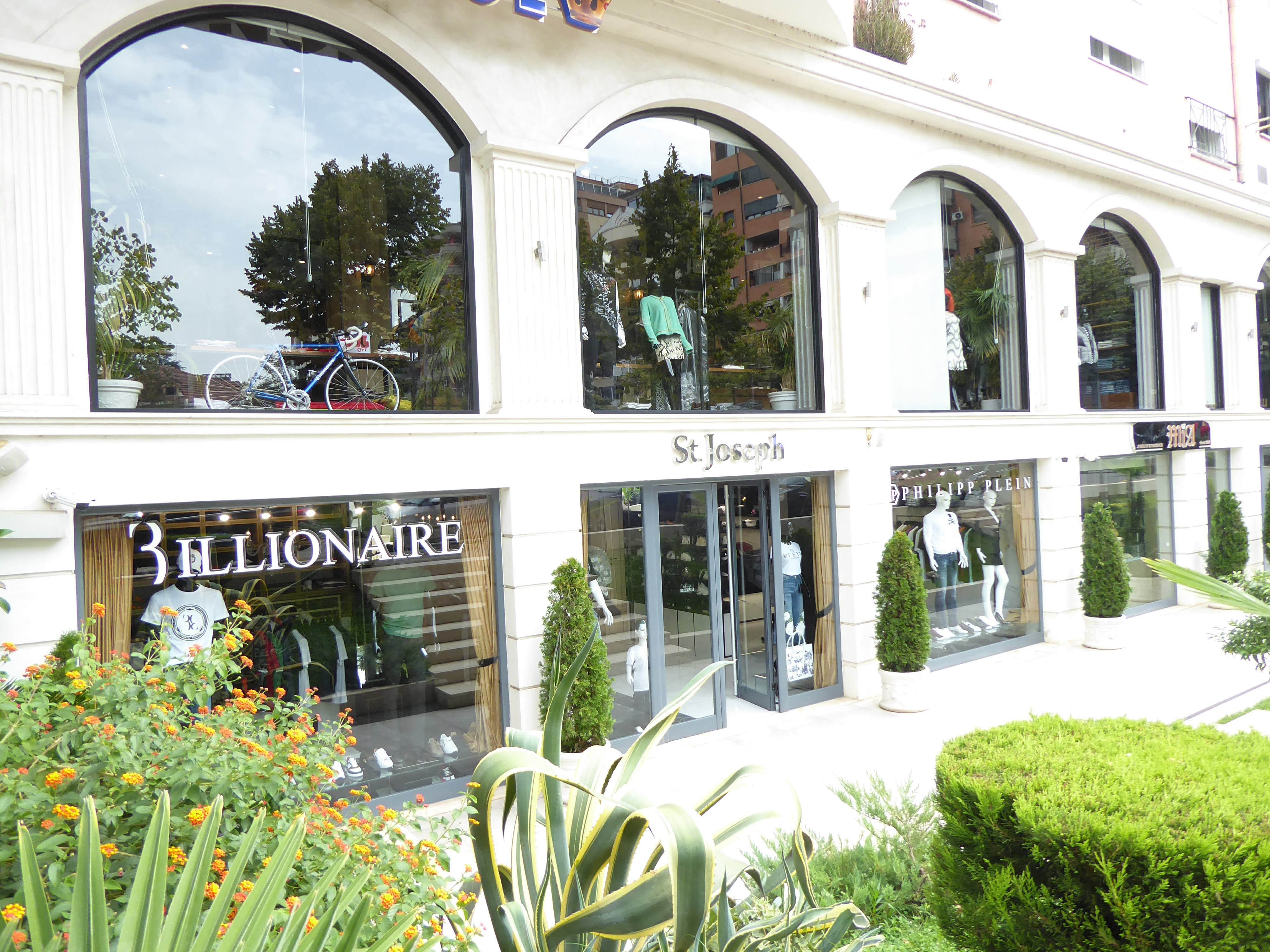
                                                                                                                                       Luxury shops.
One of the thousands of bunkers built throughout the country.

The driver had already packed our cases into the bus so we were picked up in the middle of town and driven a couple of hours  to our next stop which was the  town of Elbasan, where we had lunch before having a look at the small town.

There are just a couple of walls remaining of the Ancient Elbasan Castle which enclose the cobbled streets of the town.
One wall is centred around the clock tower


This is the King Mosque one of the earliest shrines in Albania. It was built at the end in 1492.

Back on the bus to Pogradec, our stopping place for the night. The journey from Elbasan took us along winding mountain roads. We stopped briefly to enjoy the view of Pogradec and Lake Ohrid.


 Once checked in we went for a walk to the lake which was 5 mins from the hotel. Lake Ohrid is  the deepest lake (285m) in the Balkans and borders Macedonia and Albania. In 1980 UNESCO proclaimed it a Natural Heritage site.


In the evening we ate in a restaurant overlooking the lake. 
C and I shared a very large fish caught in the lake, known here as Koran but also known as Ohrid trout. You choose the fish you want which is then weighed and you are charged per kilo. This was the most expensive meal we had in Albania and cost £18 each for the fish, a large plate of grilled vegetables and a bottle of the local red wine. There was easily enough fish for 3-4 people. 
On the way back to the hotel we passed a dessert bar and just had to go in to view the pastries etc. I ended up with a mixed fruit milkshake which tasted infinitely better than it sounded. It seems like the tour is turning into the culinary highlights of Albania.

Sunday, 8 October 2023

Day 1 Tirana, Albania

 This 10 day trip is with Exodus, a company I haven't used before as I always use G Adventures, so it will be interesting to compare. I met up with M and C at Heathrow to catch an early flight to Tirana, the capital of Albania. 


We were met at the airport by our guide for the week, Edion and our driver who was happy for us to call him Mr D. We had a brief orientation walk with Ed as we all needed to exchange money. Albania has a closed currency, meaning we can only exchange currency from within the country. As opposed to many countries at the moment, Albania uses cash rather than cards.

There was an abundance of fresh local fruit and vegetables in the local bazaar.
There were 16 of us altogether in the group, the majority being British. After we had all checked into the hotel, Ed gave us a brief history of the country and I realised I should have read much more about the country before the trip. Ed was passionate about the history of his country and did go on a bit and I did find it difficult to follow at times. Briefly, the Albanians are descended from the Illyrians, an ancient Indo-European people who lived in central Europe and migrated south by the beginning of the Iron Age. The area was ruled by the Romans by the 1st century BCE and then it became part of the Byzantine Empire in the 4th century. In the 14th century they were ruled by the Ottoman empire. The country did not achieve independence until 1912. In 1939 Albania was invaded by Italy, but when Italy surrendered in 1943 the Germans stepped in and occupied Albania. In Oct 1944 the Germans withdrew from Albania and then in Nov 1944 the communists entered Tirana. After the war a socialist government was formed under Enver Hoxha. Gradually the country cut itself off from the rest of the world and remained isolated until 1992 with the election of a non communist government.
Before we went out for an evening meal we went for a stroll around the centre of town.
Surrounding the town were mountains which became clearer as the day wore on and the haze lifted.


 I didn't expect to see a hot dog seller. In fact I didn't see another one.


There was some interesting lighting around the town.
Some very modern skyscrapers.
Couldn't work this one out until Ed told us that the windows sticking out formed the shape of Albania.

This is the 'Resurrection of Christ' cathedral. The corner stone was laid in 2004 and took 7 years to complete. From 1944 until 1990 every expression of faith was prohibited and the church was disbanded. During this time any religious building was repurposed usually for military purposes. In 1998 the Holy Synod of the Christian Orthodox Church of Albania was formed.  
Inside the cathedral there is a very impressive dome with an enormous chandelier hanging beneath it.


 This is Bunk'Art 2 which was secretly built as a nuclear bunker between 1981 and 1986 and has recently been transformed into a museum. Like many other bunkers of this size, it was built to withstand a potential chemical and nuclear attack. Actually the bunker was never even used for training. The Prime Minister Mehmet Shenu as well as the dictator Enver Hoxha who ordered its construction, never saw it completed as they both died before it was finished. The exit and entrance were only built recently because the original plans would have been for the bunker to only be accessed from the Ministry of Internal Affairs next door. The bunker was hidden from the public eye until its recent unveiling in 2015. The bunker building project started in the early 1970s and led to the building of 175,000 concrete bunkers of various sizes across the country. 


The museum made for some difficult reading about the communist era of Albanian history. Its focus was on the spying, torture and the executions that took place during those years.
One item that was  used for spying was this everyday broom which had a bug hidden in the handle. This was used by a maid in the Italian Embassy in Tirana which was providing refuge for an Albanian family who were being persecuted, The maid had been recruited as a spy and for five years collected information.
The siege of the Italian Embassy lasted until 1990 when Italy with the help of the United Nations finally managed to get on a plane to Rome with the six members of the Popa family. Their escape was an example to thousands of others who several weeks later invaded the Western Embassies in Tirana seeking political asylum, marking the beginning of the end of the communist regime in Albania.


To complete our first day in Albania  we went to the Oda restaurant which was hidden away behind the new bazaar. The meal was cheap compared to European prices but the quality of food was excellent. It was so fresh and tasty as was all the food in Albania. Unfortunately I didn't take any photos which was a real shame. The portions were large and we shared with the others on the table which meant we tried lots of different dishes. Pies made with a type of filo pastry were very popular and had various fillings such as leek or cheese or chicken. There were usually 4 or 5 different kinds of salad on the menu as well as stuffed vegetables and meat dishes.

Saturday, 23 September 2023

Albania

 For the next 10 days I am touring Albania. I will write about it when I return home. 


Thursday, 21 September 2023

St Botolph


St Botolph's without Aldgate Church stands at the edge of the City of London. Aldgate was the Eastern gate if the Roman City of Londinium and beyond it in the area around St Botolph's was the Romans' Eastern Cemetery. There has been a church on this site for over a thousand years. The church that we see today was built in 1744.


Inside the church were some interesting memorials. Some of which are written in old English and predate this church.


This was an interesting notice placed in a niche inside the entrance.


The organ at the back of the church is England's oldest working church organ c. 1705. It predates the current church and is attributed to the organ builder Renatus Harris.


You can't see the large stained glass windows behind the altar which is a shame.
This memorial caught my eye with the phrase'dying in want'. Although he had some success in his life with the construction of the first steamboat, a courtcase towards the end of his life meant he died in debt.
This is a painted cartouche recording the gift of an organ to the church in 1676. 

This post had a will of its own and I just couldn't put the photos in the order I wanted.


Tuesday, 12 September 2023

The BT Tower


This weekend was Open House weekend where you can visit buildings not usually open to the public. I applied for tickets to a few buildings which are allocated through a ballot. I was successful in one of them to go and see the BT Tower. Opened in 1965 as a telecommunications tower, it was known as The Post Office Tower. One year later the revolving restaurant on the 34th floor 'Top of the Tower' was opened to the public. A public observation gallery was also opened with more than 50,000 people visiting in the first three weeks. It was a very popular tourist attraction. But then in 1971, a terrorist bomb exploded on the 31st floor. Thankfully, no-one was injured but the damage to the building took two years to repair. Public access to all areas ceased and the restaurant closed its doors in 1980. So today was a huge thrill for me to finally have access to this building.
In the entrance hall are these quirky pieces of art based on telephone boxes.

This one is covered in pennies.


Another made a  very comfortable seat.
It was a hot and hazy day and unfortunately I couldn't see much in the distance but it was still exciting for me to see views from this part of London. In fact I took so many photos of what I could see outside the windows that sadly I didn't take any of the floor we were on which used to be the restaurant. The lift which is one of two that go up through the centre of the tower took less than 30 seconds to get us up here. I know newer buildings do go faster than that but it was fast enough for me. This is the only building in the country that allows evacuation by lift. Parliamentary legislation was required to allow this oddity.
For a large city, London is very green and from up here I had a good view over Regent's park and could also see lots of the rooftop gardens. The floor rotated whilst we were there as it would have done when the restaurant was open. It revolves 2.5 times per hour.


The green in the far right of the picture is Hyde park.
Another odd thing about the Tower is that it was classed as an official secret on its completion. Taking or possessing .photos of the Tower was technically an offence under the Official Secrets Act. The Tower was not marked on Ordnance Survey maps eventhough it was obviously there for all to see. It wasn't until 1993 when a member of parliament officially confirmed its existence that it could then be recognised as a national monument by English Heritage and was given Grade II status in 2003.


A  close up of Regent's Park with the semi circular John Nash terraced buildings.