I spent an uncomfortable night in the hotel. The heating was full on all night and I had no way of turning it off. I could open the velux window with the remote control but as soon as it started raining the window closed automatically. I hated not being able to see out of a window and felt claustrophobic. First thing in the morning I asked for a change of room. The only room available was on the top floor and there was no lift. I was more than happy to take that one.
 A member of staff carried my luggage up the four flights of stairs - well actually it was five because I was coming up from the basement. But I was delighted to have a very large window in the room.
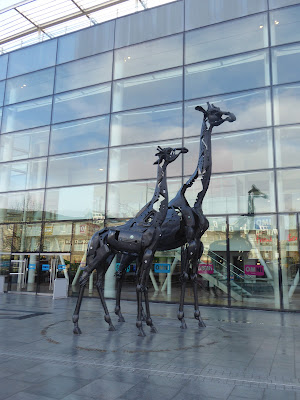
I liked this sculpture of the giraffes close to my hotel.
 It was only a 10 minute walk to the Royal Mile. The Royal Mile stretches from Edinburgh Castle to Holyrood palace. It is a long almost straight street leading to the old spine of rock on which the old town was built. It is lined with medieval tenement buildings and became so overcrowded that a new Town was built in the late 1700s. There are about 60 narrow alleys or 'wynds' that go between the buildings with names such as Fleshmarket giving you an indication of the trades that were carried out there.


 This is John Knox House. John Knox was a preacher and it is not sure how long he lived at this property but it was his connection to it that prevented it being demolished in the 1840s.The house dates back to 1470 which makes it and the Mowbray house attached the oldest surviving original medieval building on the Royal Mile.The house is associated with The Scottish Reformation ,which resulted in the outbreak of Civil War and the abdication of Mary, Queen of Scots.

James Mosman lived in the house from the 1550s. His wife had inherited the property from her parents and their initials can still be seen on the outside of the building. James Mosman was the jeweller and goldsmith to Mary, Queen of Scots. Mosman was extremely loyal to Queen Mary and he was part of the 'Queen's Men' who seized Edinburgh Castle in an attempt to restore Mary to the throne after her forced abdication in favour of her protestant son, James VI. He was executed in 1573.


I walked down to the end of the Royal Mile passing this Victorian pillar box on the way as well as many other interesting buildings.


Holyrood Palace was founded as a monastery in 1128. In 1650 it was seriously damaged by fire and major rebuilding took place. Today it is the Queen's official residence in Scotland.


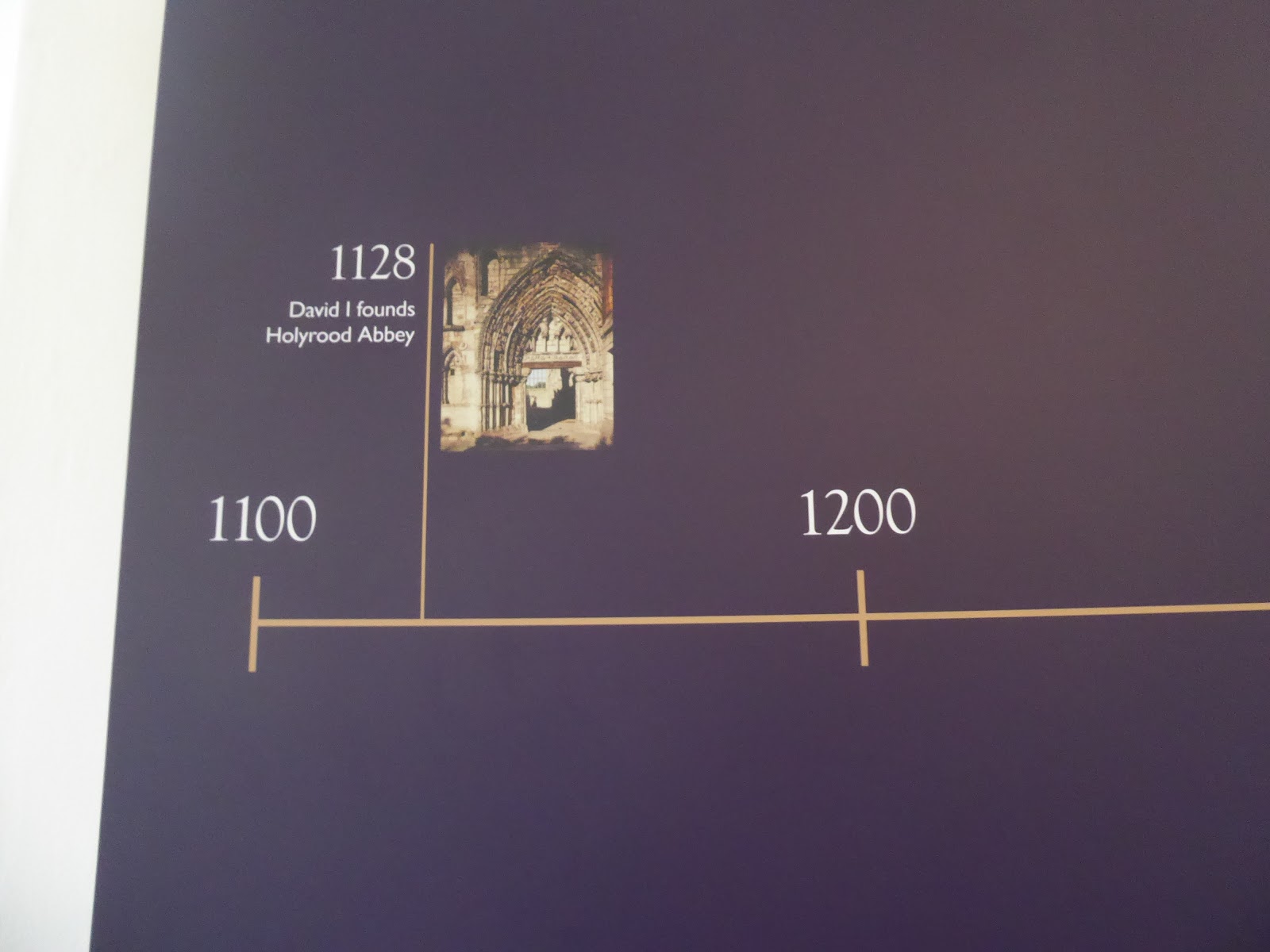
The Inner courtyard. In the 15th century the palace became a guesthouse of the nearby Abbey. Mary, Queen of Scots took up residence here in 1561. Below is a time line of the palace and abbey.
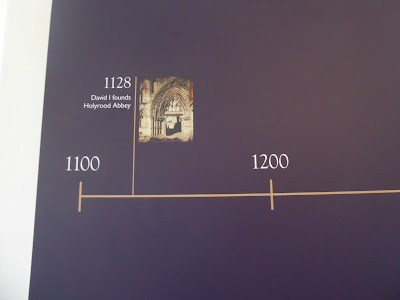
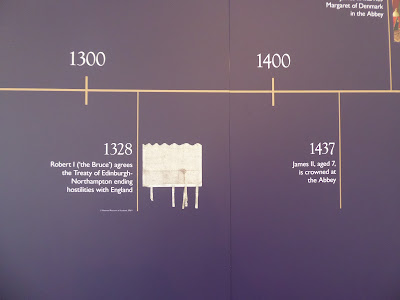

 Sorry about this one!!!!!


 This is the Grand staircase leading you into the main rooms of the Palace.
 It was empty and I was having a great time photographing away when a guard approached me and pointed out all the signs saying no photography. Whoops! I honestly hadn't noticed them. Although when he pointed them out I can't believe I missed them! The state rooms are well worth a visit and the audio guide gives you just enough information not to overwhelm you. Pity I couldn't take any more photos to show you.


Next to the Palace is Holyrood Abbey Church. The Abbey, founded by King David in 1128 as an Augustinian Abbey, was then extended over the centuries. By 1500 this was one of the largest and most impressive monasteries in Scotland.


 The Abbey was used for many important royal ceremonies including the coronations of James V and Charles II.
 The palace is set against the backdrop of Arthur's Seat, an extinct volcano towering over the city.
 Before leaving the Palace I visited the Queen's gallery where they had an exhibition of some of Leonardo Da Vinci's drawings.


 Being so close to Arthur's seat I decided to climb up. At 251m it can be seen from miles around.

 Looking down on the Holyrood Palace and Abbey

I could see the Forth Rail bridge in the distance.


 It was a bit hazy but I could see the snow on the surrounding hills. The wind was howling at the top and I was keen to take a few photos and descend to a less windy pathway down.
 Definitely worth the climb up for the views.

I made my way down and went in search of somewhere for lunch.


I liked this sculpture of the giraffes close to my hotel.


 |
On the corner of the building is a statue of Moses kneeling on top of a sundial. On the sun next to him are the Greek, Latin and English words for God. The figure used to have a miniature pulpit .below him so that he looked like John Knox preaching.
|

James Mosman lived in the house from the 1550s. His wife had inherited the property from her parents and their initials can still be seen on the outside of the building. James Mosman was the jeweller and goldsmith to Mary, Queen of Scots. Mosman was extremely loyal to Queen Mary and he was part of the 'Queen's Men' who seized Edinburgh Castle in an attempt to restore Mary to the throne after her forced abdication in favour of her protestant son, James VI. He was executed in 1573.


This is the Canongate tollbooth. Dating from 1591 it has been a council chamber and a prison. It is now a museum of everyday life.


The Inner courtyard. In the 15th century the palace became a guesthouse of the nearby Abbey. Mary, Queen of Scots took up residence here in 1561. Below is a time line of the palace and abbey.


I could see the Forth Rail bridge in the distance.


