In early December I went to an exhibition at the British Museum called: Peru: a journey in time. Through pottery, ceramics and textiles it showed the development of ancient civilisations from Central Andean cultures. Without the written word these items tell us much about the customs and rituals of those times. I visited Peru in 2009, so I was particularly interested in seeing this fascinating insight into civilisations I had no idea existed. I have tried to include descriptions and related information from the Museum display.
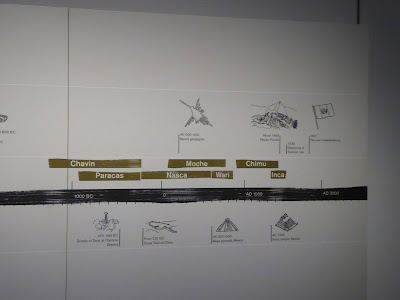
This timeline gives you some idea of the periods in history to which these items refer.
Funerary mask. Copper and shell, Moche, AD 100-800
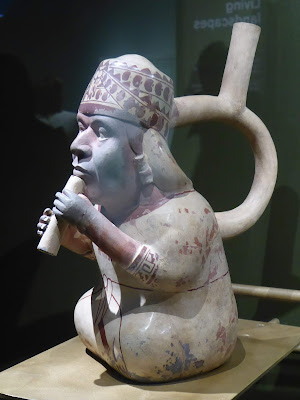
Musician playing a flute: Painted pottery, Moche, AD 100-800
Tasselled band with feather motifs: Cotton with llama/alpaca wool, Chimu AD900-1470
Llama container, painted pottery, Mocha AD100-800
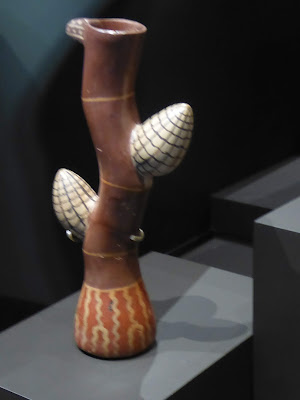
Yucca vessel, moulded and painted pottery. Moche, AD100-800
Bottle in the shape of a mythological mountain scene. Painted pottery, Moche AD 400-700
Stepped triangle vessel. This represents the mountains whilst the crest at the top symbolises water flowing through the river valleys to the sea. Moche, AD 100-800
Deer vessel, painted pottery, Moche, AD 100-800
Human deer vessel. Painted pottery, Moche AD 100-800
Maize was first grown in the Andes around 6000 years ago and has been part of people's basic diet ever since. Maize plant vessel, painted pottery, Nasca 100 BC-AD 650
Deity holding maize, painted pottery, Mocha AD 100-800
Feline. moulded, painted pottery, Moche, 200 BC-AD 500
Snake, moulded, painted pottery, Moche, 200 BC-AD 500
Bird, moulded, painted pottery, Moche 200 BC - AD 500
Ear plates with feline features. Gold alloy, semi precious stones, shell and mother of pearl. 800-550 BC
Headdress with mythical feline heads. Gold alloy, 800-550 BC
Bird shaped whistle, painted pottery, Nasca, 100 BC - AD 650
Man and woman having sex. Painted pottery, Nasca 100 BC - AD 650
Women wearing cape with intricate design. Painted pottery, Nasca 100 BC- AD 650
Shell with a woman's face, Nasca 100 BC - AD 650
Nasca vessel showing eight women seated around three vessels.
Ceremonial drum painted with mythical scenes.
Bowl with painted severed heads. Pottery, Nasca 100BC - AD 650
Severed human head vessel.
Figure holding a severed head.

Vessel depicting a figure holding a lime container and dipper. Moche AD 200-600
Vessel depicting a figure holding a lime container. Moche AD 200-600
Lime container and dipper. Gourd, leather and wood. Central coast 1400-1532.
Vessel with modelled representations of shells Pottery, Inca 1400-1532.
Ear plug showing a mythical figure. Wood and mother of pearl and shell, 1300-50
Prisoner in front of a ruler and vessel in the shape of a prisoner.
Sleeping Moche warrior with nose ring, patterned helmet, uniform and large circular ear plates.

In 1821 Peru gained independence from Spain. Today the country reflects a combination of cultures, religions and transformations. Despite centuries of colonial repression and Western influence, many Central Andean beliefs and practices live on. I hope you enjoyed seeing this exhibition through my eyes.